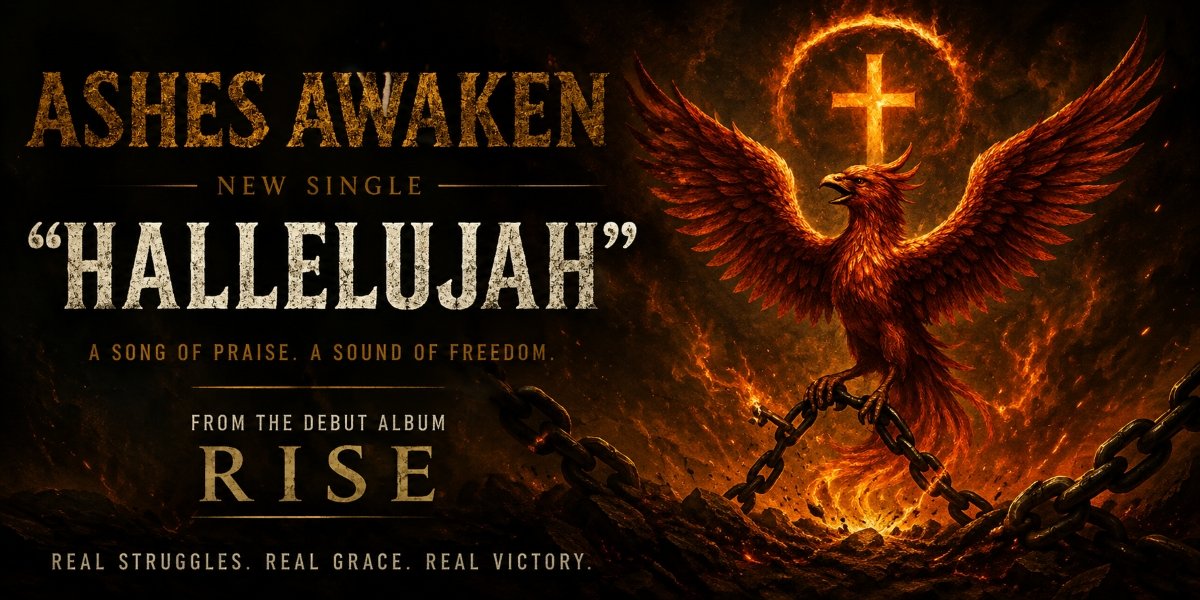

There are worse ideas than turning a praise song into a metal song. There are certainly more boring ones. Ashes Awaken’s “Hallelujah” begins with a proposition so uncomplicated that sophisticated listeners may instinctively distrust it: sing, praise, repeat. No crisis of identity required. No graduate seminar on the meaning of the chorus. No coy ambiguity concerning whom Michael Stover is addressing. He means God. He says so. Frequently.
And somehow that’s part of the fun.
“Hallelujah” originally surfaced in another guise through Dust and Grace, whose recording became a Top 5 CDX Positive Country chart hit. Ashes Awaken take Stover’s composition and put considerably more electricity through it. The theology remains intact; the guitars don’t.
The basic lyric could fit on the back of a church bulletin:
“I wanna sing something to ya
I wanna sing hallelujah.”
That’s either admirably direct or dangerously simple, depending on your tolerance for praise music. But simplicity has never disqualified a song from rocking. Chuck Berry wasn’t writing The Waste Land. Neither were the Ramones. Sometimes the trick isn’t finding more words. It’s finding the right few and making people want to shout them back.
Ashes Awaken understand this.
“Hallelujah” works because the band treats repetition as propulsion. The title keeps returning, voices pile onto it, and the arrangement makes the refrain feel progressively larger. What begins as a declaration becomes an invitation and eventually something resembling a congregation with amplifiers.
Which is precisely what this song wants to be.
The guitars carry enough weight to justify the metal tag without turning the song into an endurance test. There’s crunch, drive, and volume, but Stover hasn’t forgotten the melodic education supplied by decades of arena rock. Ashes Awaken may operate in the Christian-metal neighborhood, yet the song’s architecture owes plenty to the old belief that a chorus should be something ordinary mortals can remember before they’ve finished their first beer, or coffee, depending on which congregation you’re attending.
The crucial verse arrives when Stover moves from generic praise into autobiography:
“I wasn’t born a believer
I was a desperate deceiver
Until I found my redeemer.”
There. Three lines and the record suddenly has a reason to exist beyond getting hands raised.
Stover’s faith isn’t inherited scenery. In the Ashes Awaken universe, redemption follows wreckage. Across Rise, he has returned repeatedly to addiction, shame, failure, recovery, and Christ. That history matters because it prevents “Hallelujah” from sounding like compulsory happiness. The guy praising God is the same guy who’s been writing about crawling through darkness.
Joy sounds different when you know what preceded it.
That’s the record’s strongest argument.
The weaker argument would be that saying “hallelujah” repeatedly constitutes profundity. It doesn’t. And Ashes Awaken are fortunate not to pretend otherwise. The song isn’t a theological treatise. It’s an emotional response. Criticizing it for insufficient complexity would be like complaining that “Louie Louie” lacks character development.
The point is participation.
“Everybody praise the Lord.”
There’s your thesis.
And if you’re outside the faith, there’s still something recognizable in the mechanics. Gospel and rock and roll have been stealing each other’s tricks since rock and roll existed: repetition, testimony, call-and-response, ecstatic release. Put enough distortion behind congregational singing and the distance between revival meeting and rock show gets remarkably short.
Ashes Awaken exploit that overlap effectively.
There’s also something almost countercultural about Stover’s complete absence of embarrassment. Contemporary pop culture rewards confession but often gets nervous about certainty. You’re allowed to tell everybody you’re broken. You’re encouraged to explain your trauma. Declaring that Jesus fixed something? That’s where certain rooms suddenly develop a coughing fit.
Stover doesn’t care.
Whether that confidence attracts or repels you will probably depend on what you bring to the record. But ambiguity would ruin “Hallelujah.” A singer shouting praise while worrying whether somebody finds him unfashionable isn’t much of a praise singer.
So the band commits.
And commitment matters because “Hallelujah” is fundamentally a song about gratitude after survival. Within the larger Rise narrative, it functions almost like the celebration after the testimony. “Amazing Grace, Again” crawled through addiction toward redemption; “The Mirror” stared at regret; “A Better Way” searched for another path. “Hallelujah” gets to enjoy finding one.
That doesn’t make it the album’s most complicated song.
It might make it the most immediately useful.
Put it in a Christian rock show and people know exactly what to do. Put it in a worship setting adventurous enough to tolerate the guitars and the same thing happens. The song collapses the distance between concert and congregation because Stover understands that both depend upon communal release.
So, yes, it’s repetitive. Yes, it’s unabashedly evangelical. Yes, subtlety packed its bags several exits ago.
Good.
Not every spiritual experience requires a whisper.
Sometimes gratitude deserves an amplifier.
And sometimes four syllables are plenty:
Hal-le-lu-jah.