
By: Bernard Graham
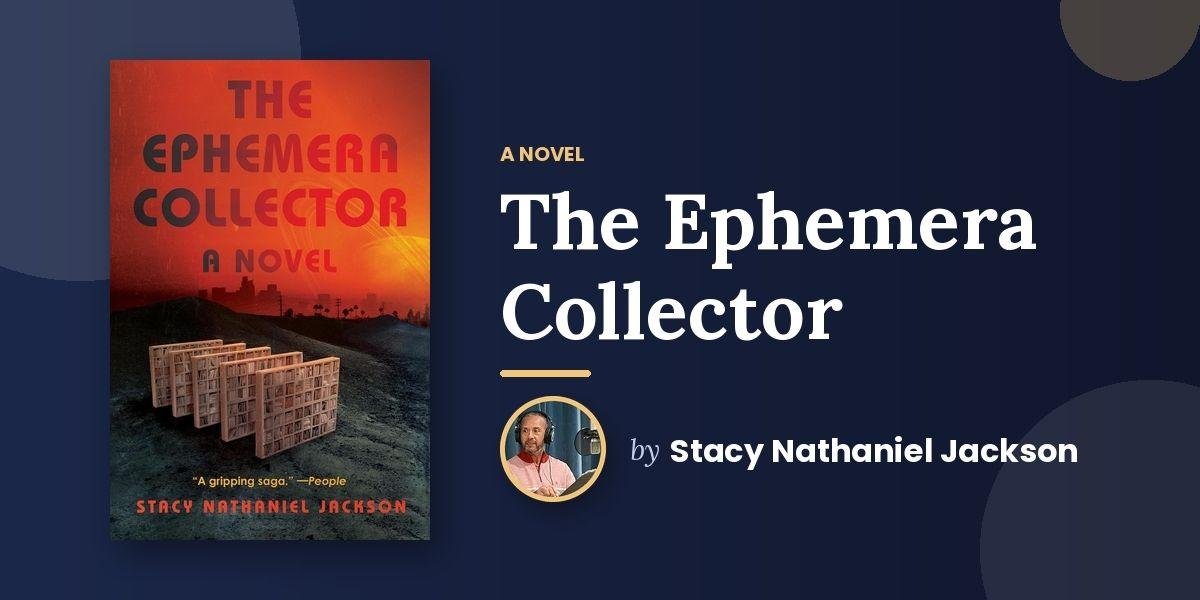
There are debut novels that announce a new voice, and there are debut novels that announce a new way of seeing, a new structural imagination so thoroughly its own that the form itself feels expanded by the encounter. Stacy Nathaniel Jackson’s The Ephemera Collector belongs to the second category, and the critical response it generated, a starred review from Library Journal, inclusion in best new science fiction lists from The Millions, Gizmodo, Book Riot, and Reactor, and a shortlisting for the 2026 William Saroyan International Prize for Writing, reflects the genuine originality of what he has accomplished in his first work of long-form fiction. Jackson is a trans poet, playwright, and visual artist whose work has appeared in Electric Literature, the Georgia Review, and New American Writing, and The Ephemera Collector carries the multidisciplinary intelligence of all of those practices simultaneously, building a novel that is as visual as it is jolting, as structurally ambitious as it is emotionally resonant.
Xandria Anastasia Brown is the curator of African American Ephemera at the Huntington Library in Los Angeles in the year 2035, crafting a mosaic of Black history through quotidian artifacts while the world around her fractures and reorganizes in ways both familiar and genuinely strange. When she becomes the target of a violent plot and must rely on her AI assistive technologies for survival, the novel opens outward from that immediate crisis into an astonishing breadth of territory: the scorched earth of climate-changed California, Diwata, a separatist underwater nation inspired by Octavia E. Butler’s legacy, the far future where an immortal Xandria attends a symposium, the cosmos, and even the inner lives of the bots themselves who are caring for and in turn cataloguing her. That breadth is not indulgence but vision, the specific ambition of a writer who understands that Afrofuturism at its most powerful does not simply imagine a different future but imagines different relationships between the past, the present, and the possibilities that preservation makes available.
The structure Jackson has chosen for the novel is one of its most distinctive and most demanding achievements. He has arranged The Ephemera Collector as an archive in its own right, building a narrative out of fragments: prose, poetry, memos, advertisements, dream journal doodles, transcripts, timelines, correspondence, images, documents. Some chapters are simply date-stamped pictures. The novel is in the spirit of House of Leaves in its ergodic ambition, and it rewards the reader who brings patience and genuine engagement rather than passive reception. The book is best experienced in a visual format, which means the physical edition offers something the digital cannot fully replicate, and that specificity of form is itself a statement about what preservation means and what it costs when it is neglected.
The parallel Jackson draws between Xandria cataloguing artifacts and the bots in turn cataloguing her physical symptoms, emotional reactions, and biomedical data is one of the novel’s most thought-provoking and most structurally elegant insights, capturing the radical heart of the book in a single mirroring relationship: the notion that preservation matters, that what is collected and how it is collected shapes what survives, and that this is true for civilizations and for individual human lives alike.
If you are ready for a debut that expands the formal possibilities of Afrofuturism while delivering a story that is page-turning, wildly creative, and genuinely moving at its emotional core, The Ephemera Collector by Stacy Nathaniel Jackson is exactly that book. Grab your copy on Amazon today and discover the novel that the literary world has been calling both an homage to Octavia Butler and something boldly, irreducibly original.