
The commodification of psychological resilience takes center stage in a new work from Chinese artist Chonghao Hua. Predominantly engaging with moving images and performance, in his meticulous staging of surreal work scenarios, Hua draws into relief the dissolution and reconstruction of individual subjectivity within the capitalist system of production.
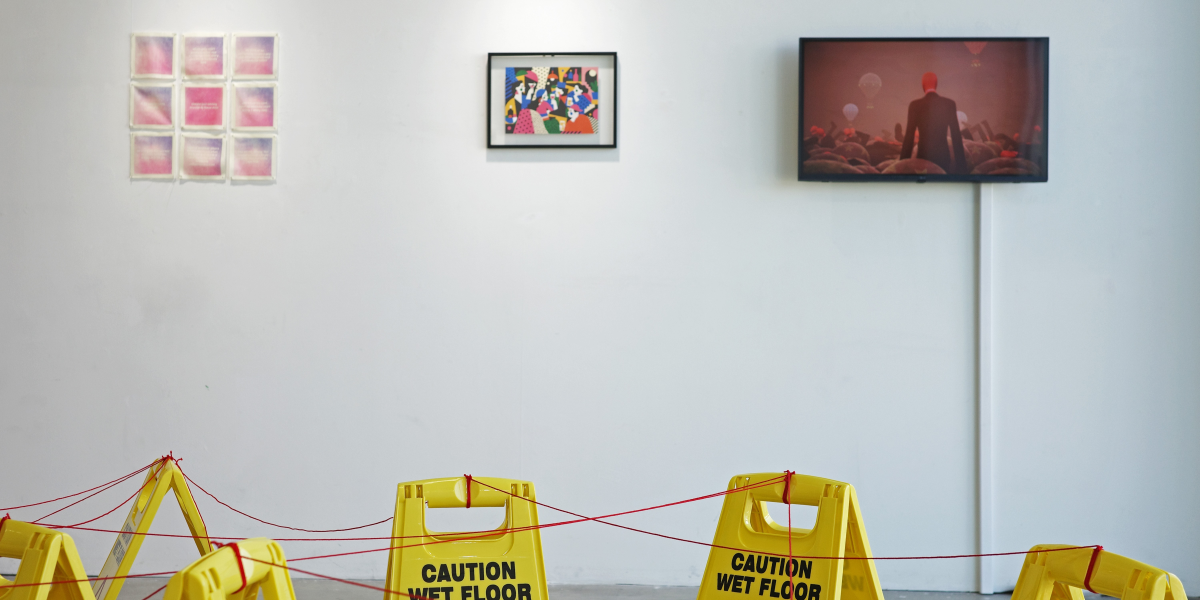
In his most recent video, Self in Alienation (2026), the artist simulates the perpetual standardization and commercialization of creative labor in our capitalist system within the eerie artifice of a fairground. The only sentient beings in the forsaken place are a homogenous production line of faceless humanoids. Inherently gormless, bowed and obedient, they present the loss of individual subjectivity and control over their own rhythmic sense of meaning in the production mechanism.

Photo Courtesy: Chonghao Hua (Self in Alienation, 2026. Installation view at the a space gallery.)
Through reiterative movements, such as the slow rotation of a Ferris wheel or the (re)emergence of whack-a-mole men, Hua speaks to ritualistic work scene organization and the predilections of contemporary labor mechanisms to gradually incorporate people into codified operational systems. In one ‘amusement booth’ the sitting duck is replaced by tiered microclones of their suited assassin. In another, the figures are impaled and thus obliged to withstand the implacable merry-go-round of life.

Photo Courtesy: Chonghao Hua (Still Image of ‘Self in Alienation’, 2026. Self in Alienation, 2026. Installation view at the a space gallery.)
In the periphery, a timer counts seconds at half-speed, reaffirming the sense of powerlessness experienced by the workers but also anticipating completion. In this sense, Hua alludes to subtle forms of systemic infiltration, asking the question: when ‘completion’ of a task is set as the sole measure of value, how can the individual be sustained within the repetitive logic of their labor, yet unable to ever truly withdraw? Across his practice, labor is more than a re-enactment of productive acts; it signals a process of constant encoding, deconstruction and reconfiguration. The progression of numbers, the accumulation of tasks and the detachment of emotion collectively reinforce a ritualized cyclical structure, whereby ‘execution’ replaces ‘expression’ and the body tends towards a lifeless mechanical state of existence. This image is familiar, veering towards the aspirations of artificial efficiency that threaten the human production chain.
When the number finally reaches 100, the task appears to be complete and the figure is rewarded with a cache of gold coins. However, it soon becomes clear that this is but another stage in the labor cycle, a false finish reminiscent of employee benchmarks for productivity that secure salary increases and promotions. In the next room, suited clones have succumbed to their exhaustion, only now, finally still.