
By: Shawn Mars
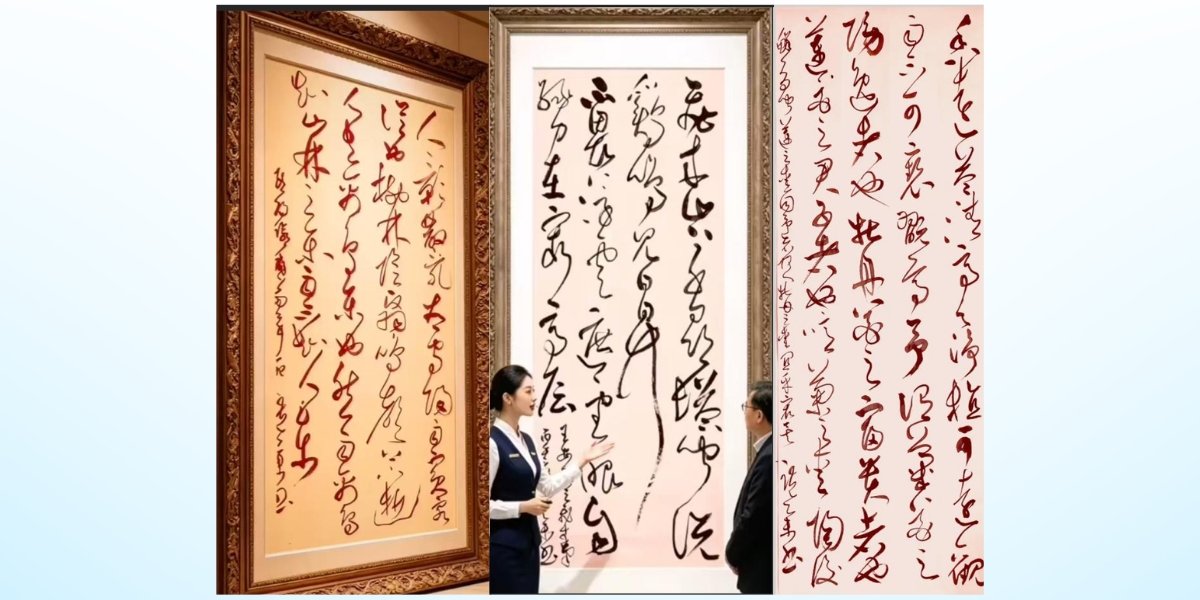
Deep within the campus of Hunan Industrial Vocational and Technical University sits a calligraphy studio filled with the lingering fragrance of ink. On the walls, running and cursive scripts flow like clouds and water, while clerical script appears ancient and profound. Within this single room, a visitor can witness the thousand-year flow of the ink brush. The studio belongs to the calligrapher Jiang Guangju. Born in 1968, he earned a master’s degree from the Fine Arts Department of Nanjing Normal University, where he studied under contemporary calligrapher Wei Tianchi and seal-carving artist Ma Shida. For decades, he has cultivated his craft, studying ancient and modern rubbings and inscriptions in depth. His work has been featured in professional calligraphy publications and recognized in national calligraphy competitions. Meeting Jiang Guangju for the first time, one finds him gentle and elegant. When the reporter turns to the current state of the contemporary calligraphy scene, though, his expression becomes solemn and thoughtful. The following is a transcript of this exclusive interview.
Reporter: Mr. Jiang, your calligraphy career can be described as being rooted in tradition for many years. From “Ink and Brush Reflect the True Heart” to “Drawing from the Past and Embracing the Present,” how do you view the criticism often heard online that “contemporary calligraphy is purely profit-driven”?
Jiang Guangju: Although the criticism is harsh, it does capture some of the chaos in the current calligraphy scene. Still, we need to be clear about one thing. This is not the “essence” of calligraphy as an art. It is an “alienation” that appears in some practitioners who, driven by commercialization and self-interest, have strayed from tradition and from artistic principles. I see two causes. The first is the rupture of traditional foundations. The second is the excessive spread of utilitarian thinking.
Reporter: You mentioned the “rupture of traditional foundations.” What are the specific signs of this in how calligraphy is learned and created today?
Jiang Guangju: This is a crucial question. The clearest sign is the alienation in how people learn. The ancients said, “It takes ten years to sharpen a sword.” Learning calligraphy is a long process of self-cultivation, moving from a foundation in regular script to running and cursive scripts. Today, though, “crash courses” are everywhere. Many people skip basic copying and jump straight to so-called “innovation,” which is a textbook case of “water without a source.” I have met young learners who have never studied classic rubbings such as the Lanting (Preface to the Poems Collected from the Orchid Pavilion) or the Ji Zhi Wen Gao (Draft of a Eulogy for My Nephew) in any depth. Yet they equate “ugliness” with “individuality” and read “weirdness” as “innovation,” which feeds the spread of “ugly calligraphy.” This aesthetic confusion is rooted in the loss of classical language. The rise of computers has made this worse. Calligraphy has lost its everyday practical function in daily writing. It has slipped from a path of self-cultivation into pure visual art, and its broad appeal keeps shrinking.
Reporter: Then how, step by step, has utilitarianism driven the “deterioration” of calligraphy as an art?
Jiang Guangju: Utilitarianism is what drives the “purely profit-driven” behavior. Take “exhibition style.” To be selected for shows and win awards, some creators deliberately cater to the judging criteria. They chase visual impact through large characters, heavy ink, and exaggerated composition, while ignoring the core of brushwork and emotional expression. This is writing for the exhibition hall, not writing for the heart. The chaos in the market is even more troubling. The “celebrity effect” has badly disrupted market order. Some public figures with no real foundation see their work driven to astronomical prices simply because of their status. Some calligraphers have set aside their art to study “marketing tactics,” and the result is “bad money driving out good.” In the auction market, pricing answers to the “celebrity effect” rather than artistic standards.
Reporter: Beyond the motivation behind the work, what other troubling phenomena have you seen in the form and expression of these pieces?
Jiang Guangju: The various “performative” creations trouble me the most. There is so-called “shouting calligraphy,” where the writer screams while working. There is “shooting calligraphy,” which uses a tool to spray ink. Some even write with their mouths, their feet, or their hair. This profanes art in the name of “innovation.” A related problem is an excessive sense of design. Some people spend three months on the outer form of an exhibition piece, distressing it, collaging it, and dyeing it, until calligraphy becomes pure composition. That approach loses the essential nature of calligraphy, which brings together inner thought, understanding, technique, and emotion at once. Then there is the spread of the “Jianghu” style, which leans on trembling brushstrokes and flying white to put on airs. The lines come out soft and weak, the structures loose, and flamboyant form hides a lack of technique. All of these behaviors pull away from the communicative function of Chinese characters. They weaken the textual nature of the writing and turn it into abstract performance.
Reporter: What do you think lies underneath these “alienation” phenomena?
Jiang Guangju: At the bottom, both the maker of art and the function of art have become alienated. Start with the maker, who has shifted from self-cultivator to performer. Ancient people practiced calligraphy for self-cultivation and character-building, looking inward. Modern people often do it to show themselves off and gain fame. The trouble with certain “popular calligraphy styles” today is not the exploration of form itself. It is the self-interest behind the motivation: being different for the sake of being different, creating for the sake of exhibition, and positioning for the sake of the market. The function has shifted too, from spiritual solace to market catering. Art should offer solace to a rough and impoverished life, yet the current chaos in calligraphy caters to that roughness instead. Identity also becomes confused. During the Republic of China period, scholars debated whether calligraphy belongs to the fine arts. To join the ranks of “fine art,” calligraphy slowly moved onto a path of alienation. It played down its own attributes and even tried to cut its bloodline connection with Chinese characters, which puts the cart before the horse.
Reporter: Facing such tangled and chaotic phenomena, how do you think contemporary calligraphy can “clarify its origins and rectify its essence” to find a way out?
Jiang Guangju: Whatever the era, returning to the essence of calligraphy is the only way out. First, calligraphy cannot be separated from Chinese characters. The primary function of those characters is communication, and any practice that violates this essence in pursuit of fame and fortune should be resisted. Second, technique and Dao have to advance together. Su Dongpo said that calligraphers and painters should advance both technique and Dao, since neither can be missing. Technique must be solid, cultivation must be deep, and character must be upright. The ancients said that “calligraphy is a painting of the mind” and that “if the mind is upright, the brush is upright.” That is exactly the point. Work that honors the function of writing and enriches the beauty of Chinese characters deserves encouragement, both for its integrity and for its innovation. The “pseudo-calligraphy” that abandons communication and chases only profit deserves to be refused and kept at a distance in practice. Calligraphy belongs to the public and speaks to the refined and the popular alike. It should not be built up into a “cage” cut off from ordinary people.
Reporter: In such a restless era, as a calligrapher who upholds tradition, how do you view your own work?
Jiang Guangju: I always keep in mind my mentor, Mr. Ma Shida’s teaching. For me, calligraphy is a “painting of the heart,” a lifelong practice of self-cultivation. In the face of the market, I choose to “draw from the past and embrace the present” and stay true to my original intention. True calligraphy is an art where the heart and the hand answer to each other, where technique and Dao advance together. It concerns our cultural lineage, not just the numbers at an auction. The path is lonely, but it is solid.