
By: Lee Sharrock
In Lost in the Forest, photographer and multimedia artist Kaiyuan Yang invites viewers into a world that usually remains hidden from the sight of human beings. He combines photography with technical innovation and a painterly sensitivity, with a profound ethical commitment to the natural world.
The result is a series of nocturnal animal portraits that are visually arresting and quietly contemplative, revealing moments of the animal and bird kingdom that are rarely witnessed by people.
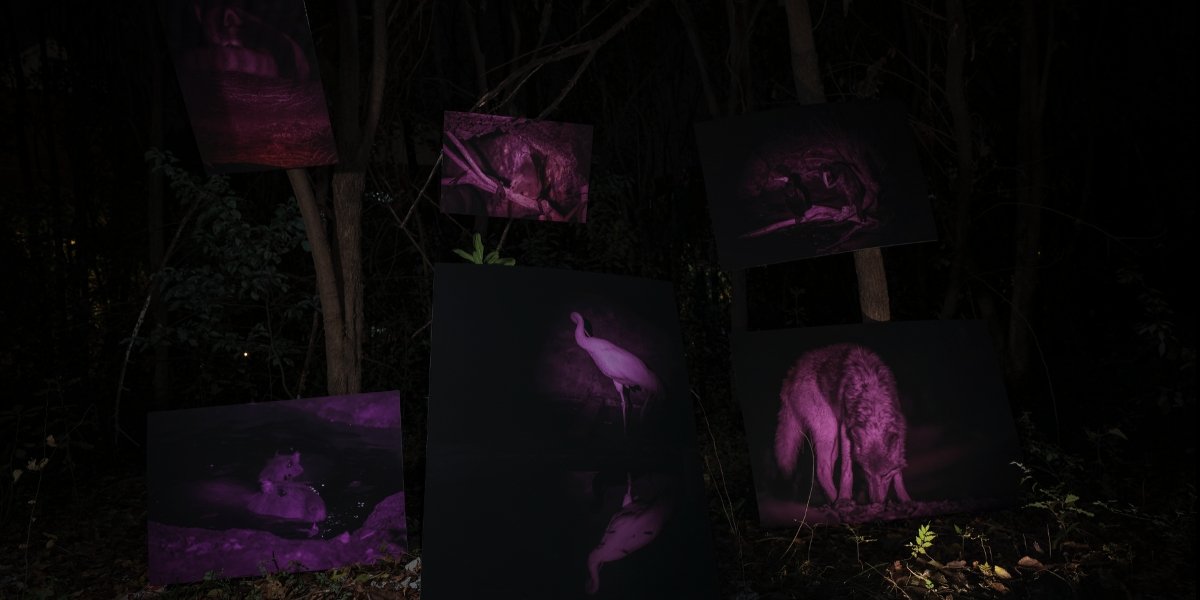
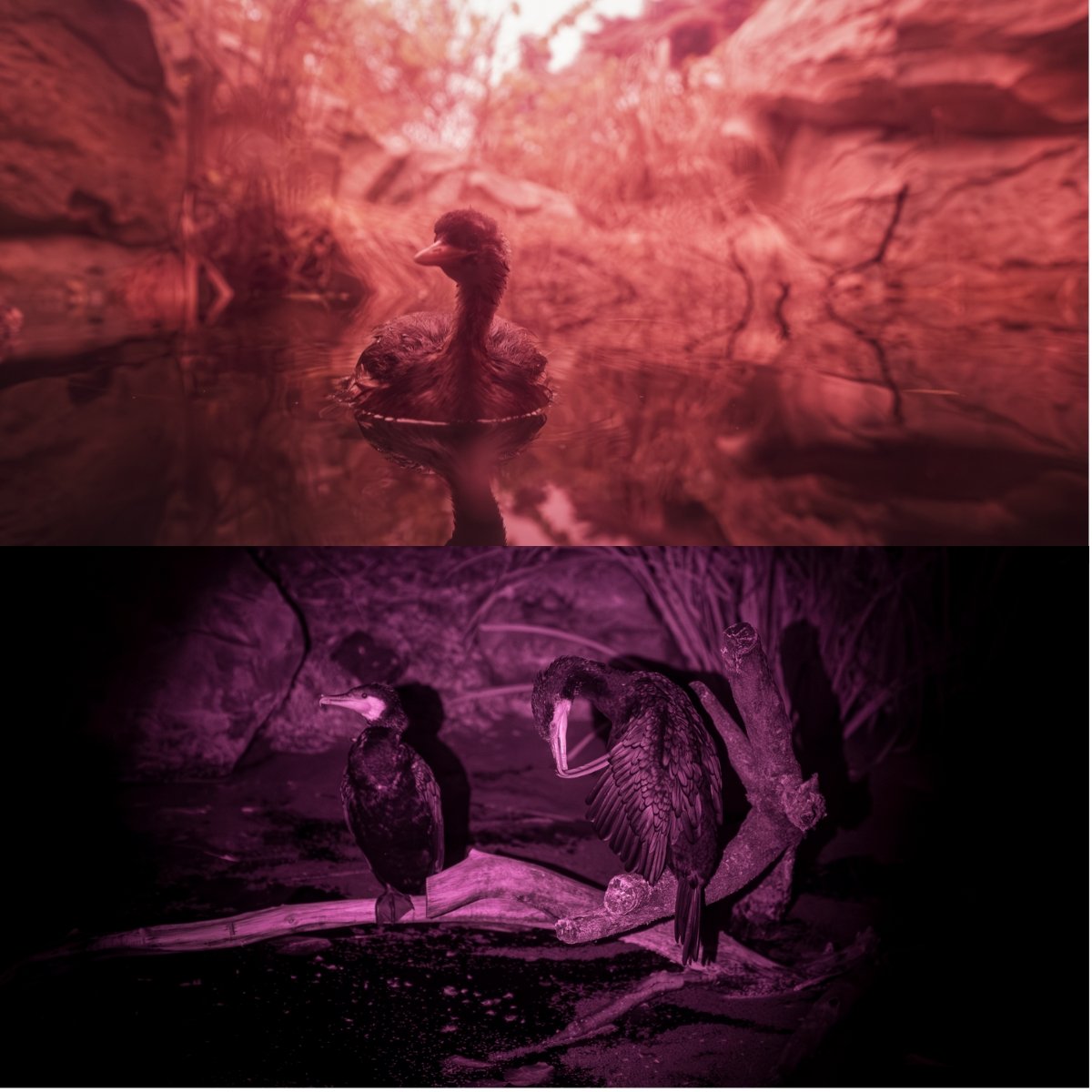
For his new body of work, Yang decided to use infrared photography to record the nocturnal behavior of animals without disrupting their natural environment. Conventional wildlife photography tends to rely on artificial lighting, an unnatural intervention that can be disturbing for the creatures under the lens. So Yang decided to use 850nm infrared light, which is imperceptible to animals, which meant he was able to photograph his subjects yet remain unseen. With Lost in the Forest, Yang has created a series of unusual photographic images imbued with remarkable stillness. He photographs some beautiful and rare birds and animals, including Capybaras, Cormorants, a Slow Loris, a Little Grebe, an Emu, a Great Hornbill, a Red Panda, and a Chimpanzee.
Yang’s images are imbued with a remarkable stillness: animals perch, forage, sleep and rest, completely unaware of the camera’s presence. He succeeds in recording their nocturnal behavior with unguarded authenticity, since they are unaware of his momentary presence in their world.
Yang chose the Nanjing Hongshan Nature Reserve in Jiangsu Province, China, as the location for his infrared photo shoot. The Reserve is home to many animals rescued from the wild and former circuses and is designed to help them reacclimatise to life in the wild. Yang’s love of wildlife and passion for spotlighting the fragile relationship between humans and the natural world, combined with his outstanding technical ability and innovative framing, result in images that have an anthropological aspect as well as an artistic aesthetic.
During a period that Sir David Attenborough and other prominent experts on the natural world and scientists have described as the Sixth Mass Extinction, with temperatures rising and animal habitats and populations diminishing, Yang’s Lost in the Forest photographic series is a timely and important exploration of how urbanization encroaches upon wildlife habitats. His images celebrate the beauty of animals and also serve as a warning that we need to treat wildlife with more care and respect, or we risk endangering further the vulnerable animals and birds that we share this precious planet with.
One of the most compelling images in Yang’s series is a portrait of a sleeping chimpanzee, its eyes closed and one hand resting against its head, in a pose uncannily reminiscent of Rodin’s infamous sculpture The Thinker. This image illustrates how close in intelligence and characteristics chimpanzees are to humans.
Yang’s lens records for posterity fleeting moments in the lives of animals and birds: a cute pair of Capybara’s take a nighttime swim, perhaps cooling off under a moonlit sky; a Chameleon clinging determinedly to a branch; a duo of Cormorants sit proudly in the nook of a tree, their glossy black feathers highlighted by Yang’s infrared camera; and a Slow Loris takes it slowly as it walks along a branch, as if on a tightrope, eyes gazing skyward and little claws gripping tightly. A Red Panda, Little Grebe, Emu, and Great Hornbill also star in Yang’s captivating photographic series.
Such moments invite viewers to consider the blurred boundaries between human and animal experience. There is an anthropological dimension to Yang’s practice, an underlying curiosity about how nocturnal rhythms shape behavior and whether animals, like humans, are increasingly affected by urban life and human intervention.
The success of Lost in the Forest is partly thanks to Yang’s technical ingenuity. He decided to modify a Sony A7S2 and Nikon D7000 for his project by removing their infrared cut filters and replacing them with clear glass to preserve optical distance. After extensive experimentation with varying infrared wavelengths, Yang was able to develop a bespoke night-vision system capable of capturing fleeting moments in near-total darkness. His clever process of adaptation and invention shows how the patience and sensitivity required to work with living subjects that cannot be directed or controlled.
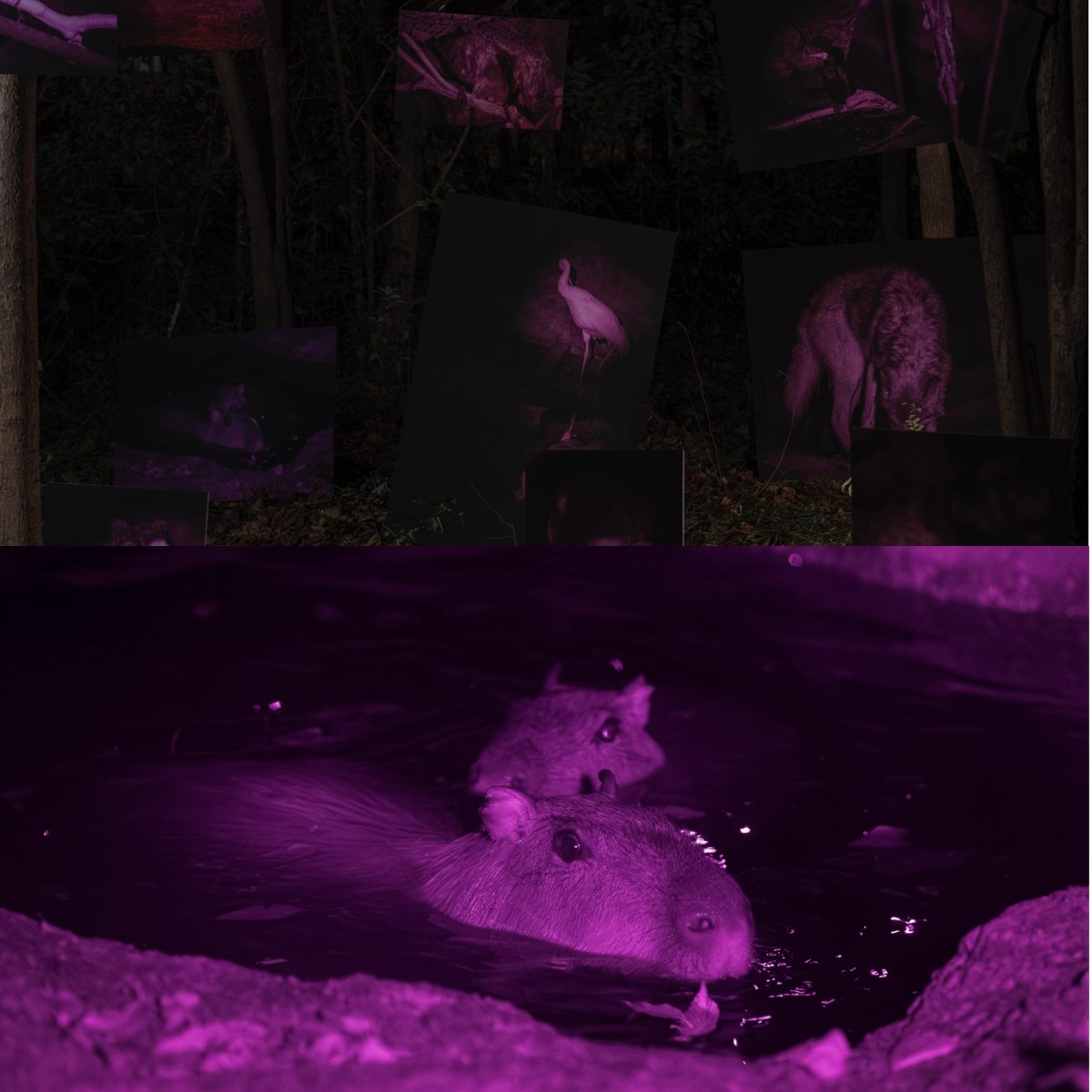
Yang’s decision to exhibit Lost in the Forest within a small woodland setting in London, rather than in a traditional gallery space, ingeniously situates the photographs within an environment that echoes its subject matter. His woodland exhibition collapses the distance between images of birds and animals and their natural habitat, using the forest as an exhibition space and canvas, thereby providing a conceptual extension of the photographs.
Apart from finding inspiration in the animal kingdom, Yang was inspired by iconic nature documentaries such as Winged Migration, Microcosmos, and Night on Earth. Lost in the Forest invites us into a hidden nocturnal realm of the natural world with extraordinary sensitivity.Through his lens, he has patiently observed his bird and animal subjects with authenticity and empathy, thereby demonstrating how technological innovation (if used ethically) can deepen rather than dominate our understanding of the natural world.