For many people, the idea of becoming an artist exists somewhere between longing and hesitation. It can feel distant, impractical, or secondary to a more stable profession. Olga Timireva knows that tension intimately. Today, she identifies simply as an Artist, but her path to that title was neither linear nor inevitable. It was shaped by discipline, displacement, and a willingness to step into uncertainty without guarantees.
Timireva is currently in the midst of a profound life transition. In recent years, she has changed countries, redefined her professional direction, and entered the art world in a more public and intentional way. Rather than presenting this period as a finished transformation, she sees it as an active process. This article captures a moment still unfolding, one she hopes will both document her position in time and connect her with others navigating similar changes.
From Courtrooms to Canvases
Before committing fully to art, Timireva spent years working as a human rights lawyer. It was not a placeholder career. She valued the structure, responsibility, and analytical depth the profession required. Law offered clarity and long-term planning, qualities she once depended on.
At the same time, drawing had always been present in her life. Encouraged by her parents and driven by personal curiosity, she created consistently, even if not publicly. For a long time, however, pursuing art professionally felt unrealistic due to its instability. Choosing law seemed practical.
After 2022, continuing her legal career became increasingly difficult. Faced with shifting circumstances, she reassessed her priorities. By then, years of disciplined work had provided her with enough financial security to tolerate the early unpredictability of an artistic path. What once felt too risky began to feel necessary.
The transition was not just professional but psychological. Moving between countries while leaving behind a clearly defined identity required her to rebuild her sense of stability. For someone accustomed to control and planning, this meant accepting ambiguity as part of daily life.
A Different Perspective on Art
Timireva’s legal background continues to influence her artistic approach. Rather than seeing art solely as self-expression, she understands it as a form of inquiry. Her training sharpened her attention to context, structure, and nuance. These qualities now inform her visual language.
She describes herself as someone in transition—between professions, countries, and ways of thinking. That state of in-betweenness shapes her work. She is particularly attentive to overlooked details in everyday surroundings, revealing beauty in objects or moments that might otherwise go unnoticed. For her, engaging with this quiet beauty brings balance and connection.
One early experience as a decorator captures this sense of rediscovery. While working on a project that required creating the atmosphere of a Wild West saloon, she was asked to craft a decorative dartboard and handmade darts. As she shaped feathers into functional objects, she felt both surprise and recognition. It was as though a dormant “internal neural network” had been activated; skills and tactile knowledge resurfaced after years of remaining unused.
The client was pleased with the result. More importantly, Timireva felt aligned with herself. The moment confirmed that creativity had not disappeared during her legal years. It had simply been waiting.
Early Milestones and Ongoing Growth
Timireva considers herself to be at an early stage in her artistic career. Rather than emphasizing accolades, she focuses on first steps: participating in exhibitions, preparing new projects, and gradually establishing a presence in the art community.
She has contributed to charity initiatives, creating murals in a kindergarten and in a chemotherapy ward in Belgrade. These projects allowed her to see how visual environments can affect emotional states, particularly in sensitive spaces.
She also worked as a leading artist-decorator at the international festival organized by Apologia Arts, an experience that expanded her understanding of large-scale collaboration. Additionally, she received a three-year contract offer from ARTSEEKER Gallery in Brooklyn. While not yet finalized, the offer marked an encouraging sign as she continues to define her direction.
Perhaps the most personal milestone, however, was her first exhibition. To celebrate it, a family member created a handmade medal for her. The joy she felt receiving it remains one of her most genuine professional memories. That reaction, she says, reflects how she relates to this stage of her journey—with seriousness, but also with childlike sincerity.
Red, Shadows, and Dialogue with Sound
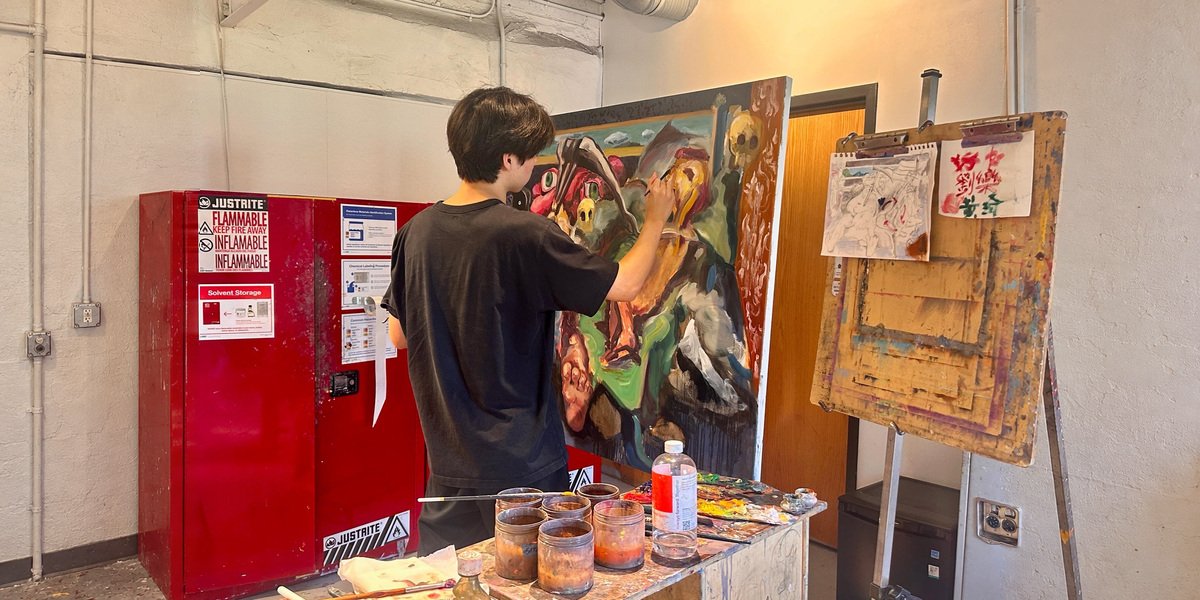
Until 2022, Timireva’s artistic practice was sporadic and largely private. She had worked at different times as a portrait artist, experimented with illustration and animation, and produced a substantial body of unseen work.
Once she stepped fully into the art community, she began presenting earlier projects publicly while developing new conceptual series. Red explores how a single color can transform perception, shifting the emotional charge of familiar objects. Shadows examines how the absence of light alters meaning and invites reinterpretation.
Music plays a central role in her creative process. Collaborating with contemporary composers, she has produced visual series that later became album covers. For Timireva, painting and music exist in dialogue, each extending the emotional and spatial possibilities of the other. Her ongoing work can be followed on Instagram.

Photo Courtesy: Olga Timireva
Expanding into Space
Alongside her independent practice, Timireva works in scenography and decorative art. This applied direction supports her financially while offering creative expansion beyond the canvas. Moving into three-dimensional space has become increasingly important to her.
She is currently developing wooden art objects, carefully refining natural forms to highlight their inherent structure. This process allows nature itself to become both collaborator and subject. Looking ahead, she hopes to continue growing in this 3D direction and eventually move toward classical sculpture.
In the coming months, she will contribute as a set artist to large-scale events, including creating a promotional art object for Cirque du Soleil, while also preparing for an exhibition in Berlin.
At its core, Timireva’s story is not about sudden triumph but about commitment. A creative life, she suggests, is not reserved for those who begin early or follow a straight path. It is a choice that can be made multiple times. It may be uncertain and unfinished, but it is possible. And sometimes, stepping into that uncertainty is the most honest way forward.