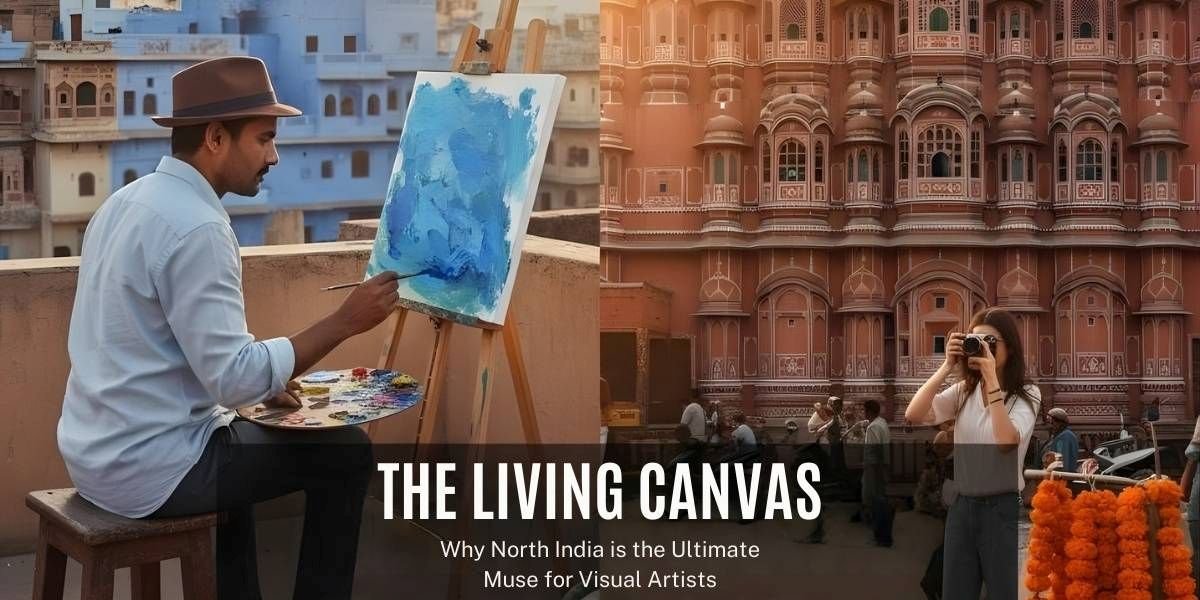

For the visual artist, travel is rarely about leisure; it is about the hunt for new light, untapped textures, and a palette that challenges their existing color theory. In the global geography of inspiration, North India stands as a “Living Canvas,” a region where the boundary between life and art is often blurred. From the sun-drenched ochres of the Thar Desert to the indigo shadows of the Himalayan valleys, this territory offers an immersive masterclass in aesthetic intensity.
Whether you are a professional oil painter, a street photographer, or a textile designer, the region can serve as a boundless studio. However, for a creator, the journey requires more than just a ticket; it requires a curated path that respects the rhythm of the creative process.
The Geography of Pigment: Rajasthan’s Chromatic Cities
In North India, color is not merely decorative; it is a cultural language. Artists have long flocked to the “Blue City” of Jodhpur, where the Brahmin-blue houses create a monochromatic landscape that shifts in value from dawn to dusk. For a photographer, the way the harsh desert sun softens against these cool-toned walls can provide a study in high-contrast composition.
Moving east, the “Pink City” of Jaipur offers a different lesson in warmth and symmetry. The terracotta-pink facades of the Hawa Mahal are more than just an architectural marvel—they are a study in repetitive pattern and rhythm. It isn’t just about the monuments; it is about the “Jharokhas” (ornate windows) and the way local sunlight interacts with ancient sandstone. For those looking to sketch their way through heritage, the most inspiring places to visit in North India may often be the tucked-away courtyards of 18th-century Havelis, where the interplay of shadow and stone creates a natural filter that no digital software can replicate.
Process Over Product: Engaging with Traditional Craft Clusters
Artist Weekly readers understand that “art” is often as much about the process as the final piece. North India is home to some of the world’s most sophisticated craft clusters, where ancient techniques are still practiced with meditative precision.
In the studios of Nathdwara and Udaipur, artists can witness the grueling precision of miniature painting, where brushes made from squirrel hair are used to render details invisible to the naked eye. In the outskirts of Jaipur, the alchemy of cobalt-blue glazing and the rhythmic thumping of hand-block printing in Bagru may provide a visceral connection to the “maker” culture.
For the serious practitioner, standard tourism often falls short. Many professional creators are now opting for specialized North India tour packages that bypass the “souvenir shops” in favor of immersive masterclasses. These curated journeys offer the chance to sit on the floor of a master weaver’s cottage or a potter’s yard, providing a deep dive into the history of the materials and the stories embedded in every motif.
The Light of the Mountains: Finding Clarity in the Himalayas
While the plains are about color and chaos, the mountains are about light and silence. For visual artists, the Himalayan foothills offer a different kind of muse, an atmospheric perspective. The way the peaks of the Dhauladhar or the Zanskar range recede into layers of hazy violet and pale grey has inspired generations of landscape painters.
Towns like Dharamshala and Landour have become hubs for artistic residencies. The soft, diffused light of a mountain morning can be ideal for those who work with watercolors or soft pastels. These altitudes act as a creative “reset button,” offering the solitude necessary for a breakthrough. The visual language here is one of scale; standing before a five-thousand-meter peak humbles the brush and forces the artist to think about the sublime.
Frictionless Inspiration: The Importance of Curation
The biggest threat to a creative breakthrough is the friction of logistics. For an artist, a missed train or a poorly located hotel isn’t just an inconvenience; it’s a disruption of the “flow state.” This is why modern travel design for the “Creative Nomad” often includes Golden Hour scheduling—helping you be at the Taj Mahal or the Varanasi Ghats during the blue or golden hours, not when the light is at its flattest.
Bespoke itineraries now focus on providing private studios and local connections, facilitating introductions to art communities and street art districts like Delhi’s Lodhi Art District. By delegating the complexity of travel to those who understand an artist’s unique clock, you move beyond being a tourist. You become part of the living canvas itself, contributing your own perspective to a region that has inspired the world’s greatest creators for centuries.
You Can Also Read: The Executive’s Guide to Recharging: Why North India is a Luxury Retreat