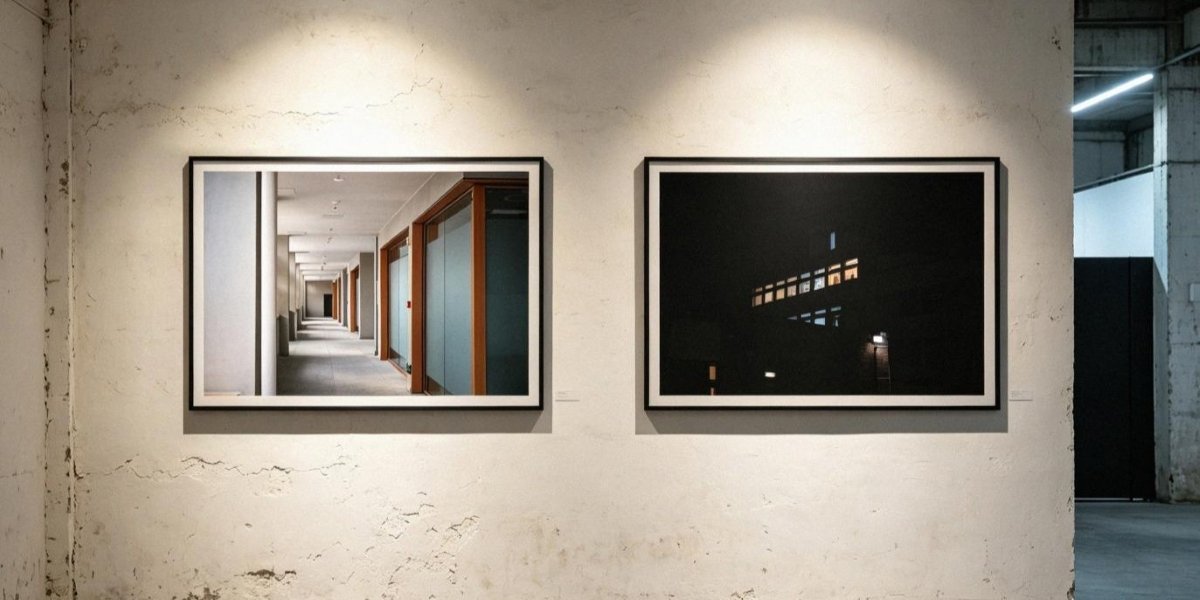

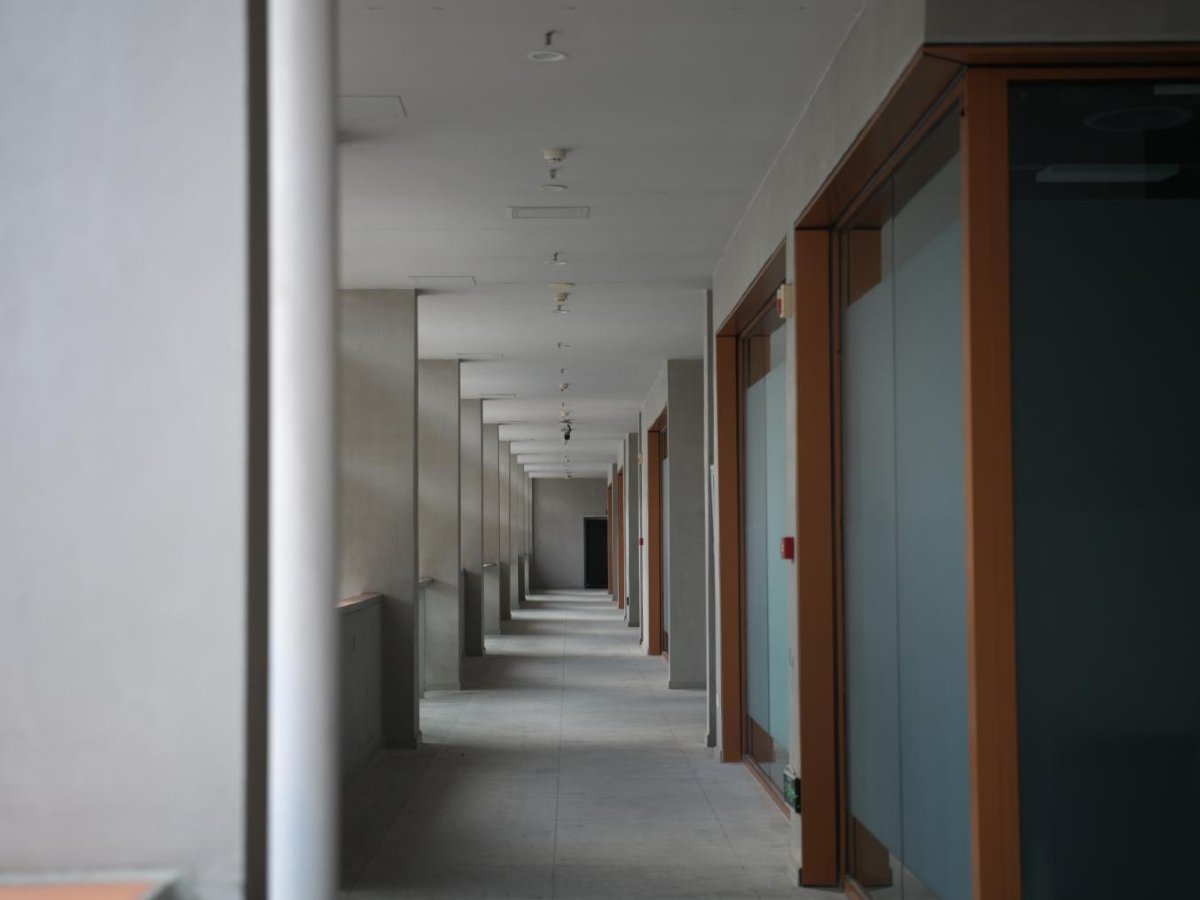
Devoid of human presence, Xiuzhuo Zhou’s photographs of buildings and interiors play with the notions of serial repetition and near-identical architectural units and components. A forensic gaze pervades Temporary Interiors: clinical, restrained, and geometricized to the extent that the grid itself comes to the fore of visual perception, suspended between materiality and abstraction as architectural pattern threatens to dissolve into pure form. This suspension allows vacancy to emerge as a marker of psychological space. The latter, the work suggests, is the only realm over which people retain jurisdiction and can inhabit with some predictability whilst facing the physical and social displacements resulting from migration to foreign urban landscapes.
Even if the work implies that our inner world is a refuge from the external upheavals linked to reterritorialization, it also states that such a world is not stable but continually reshaped by disruption. Temporary Interiors gravitates between certainties and precarities as it explores the subjective experiences of detachment and separation generated by mobility and resettlement that fracture our sense of belonging. From this perspective, the philosophical hinge of Temporary Interiors is that home, companionship and identity are not “properties” of a place but effects of an act of inhabiting, and therefore are factors that undergo transformation through relocation. By the same token, Zhou’s spectral interiors suggest that, for a diasporic person, the domestic, the safe, and the private are decoupled from ownership and permanence: to inhabit a space, however much it may alter one’s subjectivity, is not to possess it. Inhabited spaces are merely occupied dwellings that function as provisional domesticity. Space, rendered through frontal symmetry and compositional sobriety, also functions as a trace of departed bodies, pointing to a void that cannot be occupied again, not even by the bodies’ own return. Empty buildings, in Zhou’s work, thus point also to the eerie aftermath of habitation once the dweller has departed the abode.
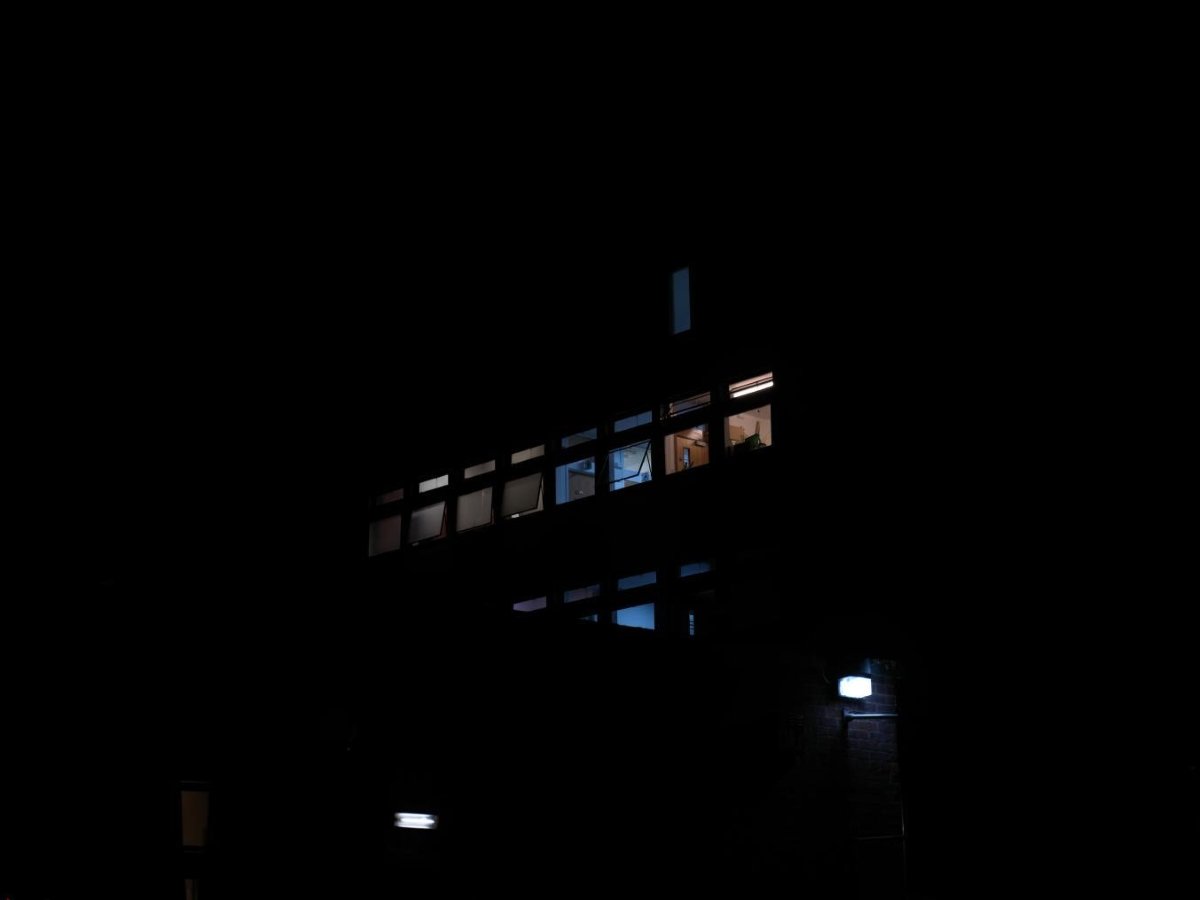
The documentary neutrality of the Düsseldorf School comes to mind, yet Zhou’s photography does not mobilise the same degree of objectivity as the German photographic lineage of the 1990s, a departure worth interrogating. In fact, his choice of atmospheric light, moving between the immediacy of stark contrast and the mood entailed in the predominant choice of illumination, produces a rhetorical effect that breaks with the school’s reticence about psychological content. For instance, Bernhard and Hilla Becher deployed homogeneous illumination to erase sentiment in the picture, whereas Zhou’s use of light charges the image with emotion, signalling that it is being offered not as a record but as interpretation. This allows Temporary Interiors to assert the affective and memory-laden connotations that this school worked to suppress.
Whilst the Düsseldorf School has been read as a way of holding Germany’s postwar memory politics at arm’s length, Zhou explores architectural form to let it speak of memory as belonging and individual transformation, and to reveal what is conceptually buried and physically absent from the urban landscapes he photographs.