
By: Jack Lee
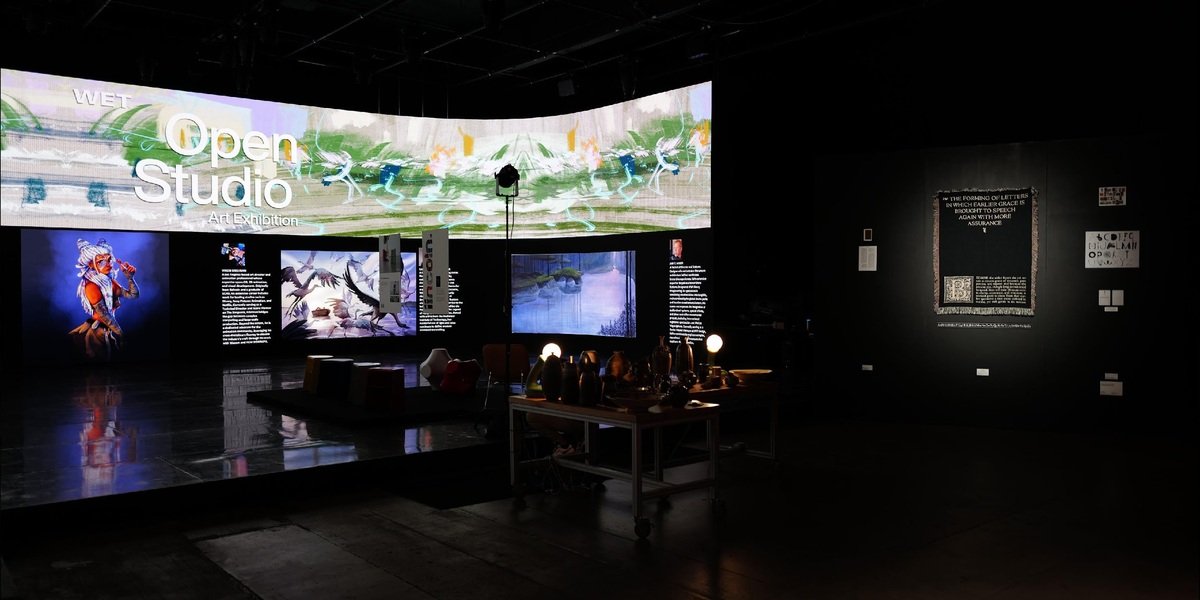
On April 17 and 18, 2026, designer Aiqi Zhang was invited to present a selection of type-driven works at the WET Art Show, a multimedia-focused group exhibition hosted by WET Design in Los Angeles. The exhibition brought together a wide range of artists and designers with distinct practices, including typographic design, furniture design, digital art, game design, ceramic art, and live portrait drawing. Together, these works created a cross-disciplinary setting where different media became tools for experimentation, interaction, and visual storytelling.
As a multidisciplinary designer working between graphic design, advertising, and type design, Aiqi’s presentation fit naturally within this multimedia framework. She approaches typography as both visual language and material practice. Her typography work explored how letterforms can move across history, cultural reference, and contemporary media. In the exhibition, typography appeared as a letterpress plate, a textile-based surface, and an interactive system shaped by photography and coding. Rather than treating graphic design as a fixed two-dimensional medium, Aiqi uses it as a way to move between material, language, image, and technology.

Among the works presented, Fairfax Cursive stands as one of Aiqi’s most historically rooted projects. “I named it after the place where I first came across it, which felt especially fitting, since so many typefaces have historically been named after places,” she says. The typeface began with an encounter during a visit with type director and collector Paul Soady, when Aiqi discovered a distinctive alphabet in one of his old books. What drew her attention was the way the forms seemed to sit between cursive and blackletter: fluid, gestural, and elegant, yet carrying a density and historical texture that resisted easy categorization.
Through close observation and structural refinement, Aiqi developed the alphabet into a more logical and contemporary typeface. Its forms retain the rhythm and movement of handwriting while acknowledging the structure and weight of older calligraphic traditions. Beyond the font design itself, she presented a letterpress plate in the exhibition, along with a typeset page using text from On the Trinity. By resetting this historical Latin text in her revived typeface, Aiqi created a dialogue between old content and a newly interpreted typographic form.
Credence Display further reflects Aiqi’s interest in reinterpretation. Inspired by Bruce Rogers’s Centaur, the typeface responds to the measured grace and quiet restraint of a historical model while moving toward a more contemporary and personal voice. The project’s material expression also expands its meaning. For the exhibition, Aiqi translated the typeface into a woven blanket, allowing the letterforms to move beyond paper and enter another medium.
Her attention to historical detail also appears in the project’s typographic ornaments. Referencing William Morris’s wood type, she combined a fleuron with her own letterform B, creating an ornamental structure that connects typographic history with her own formal language. The blanket’s layout references Bruce Rogers’s Riverside Press edition of Sir Walter Raleigh’s The Last Sea-Fight of the Revenge, reimagining its historical page structure as a contemporary typographic study. The inverted triangular composition gives the text a stronger sense of confidence and visual authority, aligning closely with the name Credence.
The third project, Fontastic, expands Aiqi’s typographic practice into a more experimental and image-based direction. Developed from everyday objects found around the WET Design office campus, the project invited participants to look at their surroundings as a source of letterforms. During the workshop process, images were gathered, shapes were discussed, and visual fragments were gradually translated into a full alphabet.

Aiqi later refined these images into a consistent type system and extended the project through generative coding, making the typeface interactive and usable beyond the original workshop setting. During the exhibition, visitors were able to use a generative system built in Processing to create customized words, names, and small graphic applications. In this way, Fontastic turned typography from a finished visual object into a participatory tool, allowing others to enter the process of making and interpreting letterforms.
What distinguishes Aiqi’s work is the way she treats typography as a living visual language, one connected to books, places, tools, memories, and the act of looking carefully. “Those projects reflect how I think about typography,” she says. “It’s not only something we read, but also something we can notice, interpret, and rediscover in the world around us.” Through this perspective, her practice offers a slower and more attentive way of understanding letterforms.
The exhibition drew a strong turnout of visitors, collaborators, and members of the creative community, giving Aiqi’s typographic work a public and participatory dimension. Audiences could encounter typography not only as finished visual work, but as something they could use, touch, reinterpret, and play with. Several visitors and collaborators engaged with Aiqi’s type system directly, using the letterforms to create personal takeaways such as name cards and small graphic pieces. Within the exhibition’s multimedia context, this interaction expanded the role of graphic design. More broadly, the exhibition encouraged audiences to see different media, across different artists’ practices, as flexible and playful tools for experimentation.
In Aiqi’s hands, type becomes a way to revisit the past, observe the present, and move across language, image, material, and code. Her work reminds us that typography does not have to remain on the page; it can take the form of a plate, a blanket, and even a way of seeing.