Across two distinct exhibitions, Entre Les Mondes (Between the Worlds) at Paris’s LooLooLook and What Remains to be Seen at Canada’s 1215 Gallery, Fang Liu explores her ongoing interest in fragility, memory, and the nuanced codes of cultural transmission. Though the exhibitions differ in tone and geography, these shows together contribute to Liu’s established curatorial vocabulary: fluid, poetic, and charged with spatial intelligence.

Photo Courtesy: Photographer Shaoyu Ba
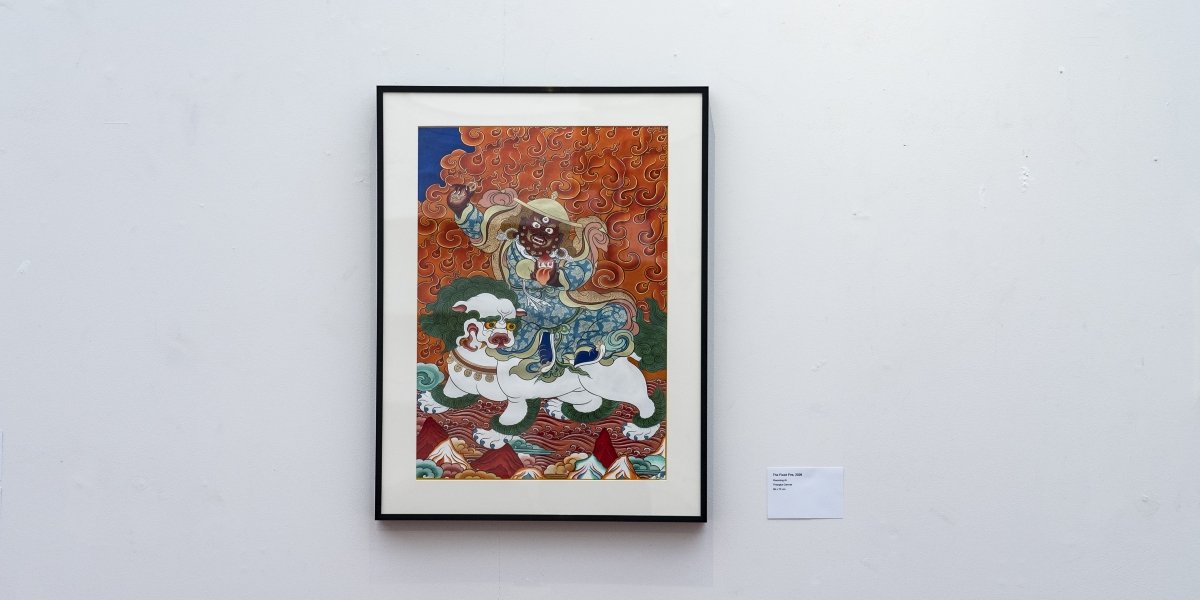
(Exhibition View – ‘From Breath to the Dirt’ – 1215 Gallery – Montreal, Canada, 2025.)
In Paris, Entre Les Mondes (Between the Worlds) is centered around the “poetics of the fragile and the invisible.” Eight artists working across diasporic identities and emerging technologies illustrate delicate thresholds: from the reflective ultramarines of Sophie Bloch’s paintings to the photography phenomenology of Zesheng Li. Bloch’s works in particular are curated to reflect this; they float without hierarchy, spaced at regulated and swelling intervals, evoking the undulation of the outremer they depict. This spatial storytelling is a core element of Liu’s curatorial ethos, which emphasizes a poetics of misplacement, recalibrated through disruption.

Photo Courtesy: Photographer Shaoyu Ba
(Exhibition View – ‘From Breath to the Dirt’ – 1215 Gallery – Montreal, Canada, 2025.)
Meanwhile, in What Remains to be Seen, Liu turns toward the minor and the unconscious within psychoanalytic theory: traces, absences, and reconfigurations serve as vectors of cultural memory and gestures that resist being pinned down. The show invites reflection on what persists beneath perception: what identities flicker in the margins, and which accidental designs of society become authors of form? The works—wry, destabilized, and materially precarious—are curated to prompt inquiries into authorship, disappearance, and the Bourdieuean divide between intended and accidental aesthetics. Liu’s curation places these pieces in conversation with each other by building connections between Lacanian ideas of lack, loss, and aversion, letting each work subtly resonate through the next, allowing meaning to emerge through adjacency.
Threaded through both exhibitions is Liu’s broader project: constructing liminal, counter-hegemonic zones where diasporic, feminine, and ecological narratives might unfold. She favors evocation over assertion, the quiet politics of spatial curation over manifesto. In her hands, the gallery becomes a membrane between technologies and myth, grief and gesture, visibility and care—a curiously generative silence in which the invisible is rendered visible, nostalgic algorithms are exposed. Her arrangement of space resists spectacle in favor of what Glissant might call opacity, that which resists being entirely grasped, creating an architecture of pacing and presence. Fang Liu’s curation resists hegemony and embraces the potential of obscurantism to exist beyond complete understanding.
About the Curator
Fang Liu (Summer) is an independent curator and creative producer based in London, focusing on the intersection of contemporary art practices and the cultural industry. Her practice resides at the junction of contemporary art, cultural research, and spatial storytelling, with particular attention to ecological aesthetics and collective memory. With a multidisciplinary background in the cultural industry and art, Fang Liu (Summer) brings a broad perspective to curatorial work that navigates across interdisciplinary fields of cultural research, art, and business.
In 2020, she founded Zero to One, an art platform dedicated to expanding visibility for Chinese contemporary artists. This platform aims to create more opportunities for Chinese artists to be seen, heard, and engaged with on an international stage. Rooted in the idea that Dao begets One, One begets Two, Two begets Three, Three begets all things, Zero to One is envisioned as a cultural home for Chinese art and lifestyle in London. Its logo visualizes a philosophical balance: the circle (“Zero”) signifies curvilinear, cyclical thinking rooted in Eastern traditions, while the line (“One”) represents the linear logic of Western methodology—together forming a neutral space between worlds.
Under this platform, Liu has curated a series of reflective and sensorially rich exhibitions, including Linger (2020), Beyond Nature (2021), Forage (2023), and Rebirth (2024), all of which continue the platform’s mission of amplifying Chinese artistic perspectives. These projects explore the porous boundaries between nature and technology, body and environment, self and society. Her approach emphasizes interdisciplinary collaboration across moving images, installation, sound, and performance, often accompanied by in-depth curatorial texts and participatory public programming.
Additionally, Fang Liu (Summer) is the co-founder and director of Asian Girls Club, a cultural space that supports and amplifies the voices of Asian women artists established in late 2020. Merging visual art, pop culture, and identity politics, the platform creates room for hybrid narratives through exhibitions, performances, workshops, and music events. Its visual identity, a monolid girl, is a self-aware and defiant reclamation of a stereotype, turning marginalization into visibility.
Fang Liu (Summer)’s curatorial sensibility is defined by fluidity, poetic clarity, and her dedication to creating space for culturally overlooked communities, including Asian women artists. Her work continues to ask how art can transform public space into a site of embodied knowledge, shared attention, and cultural transformation.